Russian Cucumbers – Quick Salt-Brined Pickles
A classic that has stood the test of time: cucumbers pickled in a salty brine with dill and mustard seeds. Within two to three weeks lactic fermentation gets going and you end up with a crunchy salty treat that goes perfectly with bread and lard. Even a beginner can manage this recipe, and the ingredients are easy to find.
Method
01.
Clean the cucumbers thoroughly with a brush and rinse them in clean water. Cut off the tips or prick the cucumbers with a fork – this speeds up the pickling time. If you are not in a hurry, leave them as they are.
02.
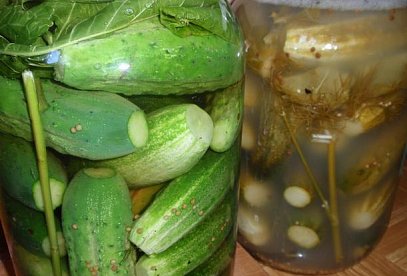
Layer the clean cucumbers in a stoneware crock, a barrel or large preserving jars. As you layer them, add dill, mustard seeds and a vine or horseradish leaf (thoroughly washed). Make as much brine as you need.
03.
For every litre of water use roughly fifty grams of salt, bring it to the boil, simmer briefly and pour the boiling brine over the cucumbers right up to the rim. The level will drop a little; if it drops a lot, top the containers up. We recommend weighing everything down so that it all stays submerged.
04.
Over the years of quick pickling, preparations such as Deko, Nako and others have also proved their worth; they already contain spices, so you only add dill and leaves to the jar with the cucumbers (2 pieces are enough for a large jar). For one Deko use about 2 litres of water and roughly one tablespoon of salt. Taste it to check the brine is salty enough, then pour it over the cucumbers while boiling.
05.
The cucumbers will be just right in 2–3 weeks, depending on the ambient temperature, which should be around 22–24 °C. It is best to store them in the dark, but if you leave them at home covered with a cloth you will not go far wrong – total darkness is not essential. If you want cucumbers for long-term storage, after a week move them to a cooler part of the house, ideally a cellar.
06.
During pickling the cucumbers will start to ferment, which means the brine turns cloudy and a white film forms. There is no reason to worry or to pour the jars away. It is normal, the cucumbers are rinsed and it does no harm. Lactic fermentation preserves the food thanks to microorganisms... and when you spread bread with lard and bite into a salty kvašák, that is the reason you will be making them again next year. Of course, sour kvašáky are made as well and they disappear just as quickly. :-)